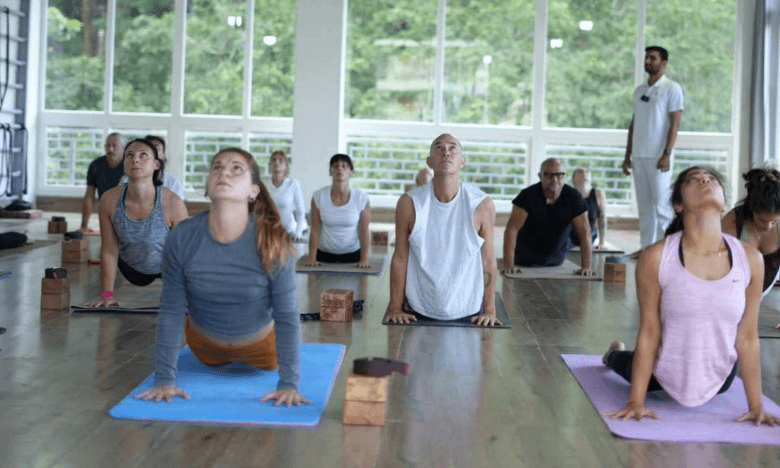
Yoga has become a part of the worldwide phenomenon, practiced in studios from New York to Tokyo. Yet, for millions of practitioners, there is a burning desire to make a pilgrimage to its source. India, a land of colorful culture, ancient tradition and deep spirituality, possesses an irresistible magnetic attraction to anyone who is serious about understanding yoga beyond the physical postures. But what makes this country the undisputed centre of the world of yoga?
The answer lies in the very fiber of India’s history and soul. It’s not just a place to practice asanas, it’s the destination of transformation. Here, yoga is not an exercise class – it is a way of life. The air thrums with a spiritual energy that you cannot find anywhere else.
Let’s learn more why India remains the ultimate pilgrimage for yoga enthusiasts all over the world.
The Birthplace of an Ancient Tradition
The most important reason why India is so popular is in its simplicity: this is where it was all started. The history of yoga can be traced back to more than 5000 years ago in ancient India. The foundational texts that constitute the philosophical backbone of the modern yoga such as Vedas, Upanishads, Patanjali’s Yoga Sutras were all composed here.
To do yoga in India then is to encounter this unbroken lineage. You are walking on the same ground where sages and yogis used to meditate and gain enlightenment. This historical context gives a depth and authenticity that cannot be reproduced. It takes the practice from being merely a workout to being a rich and immersive cultural and spiritual experience.
Access to Authentic Teachings and Guru
For centuries yoga knowledge was transmitted directly from guru (teacher) to shishya (student). This tradition has survived to the present day. India is one of the countries of origin of some of the most revered yoga masters and lineages. Gurus who spent their whole lives in the study and practice of yoga give their wisdom to sincere students.
Learning from these authentic sources is a game changer. You gain insights into philosophy, meditation, and pranayama (breathwork) that tend to get watered down in the western adaptations. A Yoga Teacher Training in India provides the opportunity to learn from teachers who learned and learned through a lifetime of embodied experience. Such direct transmission of knowledge is powerful and transformative.
A Spiritually Charged Environment
There is an intangible quality that is to be found in India and that practitioners seem to denote as a certain palpable spiritual energy. From the holy Ganges River in Rishikesh to the tranquil backwaters of Kerala, the entire nation is like a container for introspection and growth.
This is an incredibly conducive environment to doing a deep yoga practice. The daily rituals, the sound of bells on the temple and the collective devotion of the people, form a background which encourages you to turn inward. Away from the distractions of everyday life, you can focus on your personal journey, and nothing else. This immersive atmosphere helps to quiet the mental chatter and opens the door to great self discovery.
The Epicenter for Teacher Training
For those who want to pursue their practice to the next level, India is the ultimate destination. Cities such as Rishikesh, the ‘Yoga Capital of the World’, Mysore and Goa are sprinkled with world-class yoga schools (ashrams). These institutions provide a large variety of programs for all levels.
Completing a 200 hour yoga teacher training in India is a right of passage for many of the aspiring teachers. These intensive programs aim at immersing you totally into the yogic lifestyle. Mornings begin with meditation and chanting followed by long days of asana practice, anatomy lessons and philosophy lectures. This rigorous structure aids in discipline and gives a comprehensive education for building a strong foundation for teaching.
An Incredibly Affordable Option
Compared to the equivalent courses offered in North America, Europe or even Australia, yoga training in India is extremely affordable. The lower cost of living means that ashrams and schools can offer all-inclusive packages – they can provide all of your tuition, accommodation and meals for a fraction of the price you would pay anywhere else.
This accessibility allows for a deep and immersive experience to be available to a wider range of people. It enables students the comfort of being able to fully commit to their training without the excessive financial burden such commitment can have in other parts of the world. You can invest in a month long training in India what a week long retreats may cost you in the west.
See Also:7 Ways A Yoga Teacher Training Can Change Your Life
A Holistic Approach to Wellness
In India yoga is not viewed in isolation. It is part of a whole system of well-being known as Ayurveda, or the “science of life.” Many schools and Ashrams of Yoga take Ayurvedic principles into their teaching. Students learn about diet, daily routines, and herbal remedies that have complementary other than the yoga practice.
This holistic approach focuses on the mind, body and spirit, as an interconnected whole. You learn not only how to perform poses, but how to live a balanced healthy life in harmony with the rhythms of nature. This is one of the most valuable takeaways of those who make the journey to study in India, an integrated wisdom.
The Ultimate Journey of Self-Discovery
At the end, people are attracted to India for a reason that is beyond common sense. It is a call from the soul. A visit to India to learn yoga is not a vacation; it is a pilgrimage. It challenges you, moves you at the edge, and makes you face your limitations.
The sensory overload, the cultural differences, the intensity of the spiritual environment all conspire to peel away the non-essential layers of the self. You leave home, not just with a certificate or improved flexibility but with a new way of looking at life, a greater connection to yourself and a heart full of gratitude.
India is and will continue to be the world standard for yoga because it provides what one cannot find anywhere else: a direct connection to the ancient foundation of the practice in an environment conducive for a spiritual awakening.