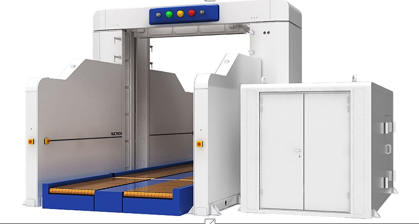
Baggage scanners have become essential to modern airports. From your toothbrush to your laptop, everything you carry is thoroughly inspected for potential threats. But how do these machines actually work? Behind their sleek, metallic exteriors lies a world of advanced technology that helps ensure safe travel. While most passengers simply place their belongings on the conveyor belt and walk through, much more happens behind the scenes.
X-ray technology and material detection
Baggage scanners typically rely on X-rays to examine the contents of bags and suitcases. These rays penetrate luggage and produce a visual image on a monitor. Security staff can instantly assess whether anything suspicious is inside. But the technology doesn’t stop there. Today’s scanners use intelligent software to differentiate between materials and highlight suspicious items.
Different scanner types serve different purposes. Handheld scanners are used for quick checks, while large CT (computed tomography) scanners offer detailed 3D views of checked baggage. A good example of this is the NUCTECH™ AC6000DE, a high-performance scanner specifically designed for air cargo inspection. This is a sophisticated system that continuously improves through ongoing innovation.
Hidden technologies that keep your luggage safe
Detecting threats without passenger awareness
Modern baggage scanning technologies are designed to detect hidden threats without disturbing the passenger experience. One powerful technique is dual-energy imaging, which helps distinguish between organic and inorganic materials. This allows scanners not only to detect the presence of an object but also to identify its composition—whether it’s an explosive, narcotic, or even a certain type of metal.
Another impressive technology is backscatter imaging. It may sound like something from science fiction, but it’s very real and very effective. Backscatter provides surface-level images of objects that traditional X-rays might overlook. This technology is often integrated into handheld scanners used to inspect vehicles or large containers quickly and efficiently.
Types of baggage scanners
There are several types of scanners, each with unique strengths. The most common are standard carry-on baggage scanners, which use a single X-ray to create a 2D image. More advanced scanners, like CT-based systems, generate 3D views, offering greater detail. These are commonly used for checked baggage.
Other variants include mobile scanners that can be transported to specific locations for targeted inspections, and handheld scanners for quick checks of small items or hard-to-reach spaces. Each type of scanner serves a different security need depending on the situation.
See also: Features To Look for in Technology Expense Management Software
Faster and safer passenger flow
One major benefit of today’s baggage scanning technology is the speed it brings to the security process. No one enjoys waiting in long queues while luggage is manually inspected. Thanks to the efficiency and accuracy of modern scanners, screening is now faster than ever. This also reduces the need for manual bag checks, minimizing delays and passenger inconvenience.
At the same time, safety is significantly enhanced—without travelers having to be overly aware of every measure in place. You simply pass through security, confident that everything is being thoroughly checked behind the scenes. This sense of reassurance makes flying more pleasant for everyone.
What’s next for baggage scanners?
Baggage scanning technology continues to evolve. With rapid advances in artificial intelligence (AI), future scanners will be even better at detecting threats—while becoming more efficient and easier to use. Machine learning algorithms are already improving scanners’ ability to identify suspicious patterns and flag dangerous objects more accurately.
Scanners will also become more compact and mobile, allowing deployment at new locations, including events and high-traffic public areas. This flexibility expands their use beyond just airport terminals.
Finally, the integration of multiple technologies—CT imaging, AI analytics, dual-energy screening—will ensure we stay ahead of emerging threats. Security will always remain a top priority, but continuous innovation means the process can become more seamless and less intrusive for passengers.